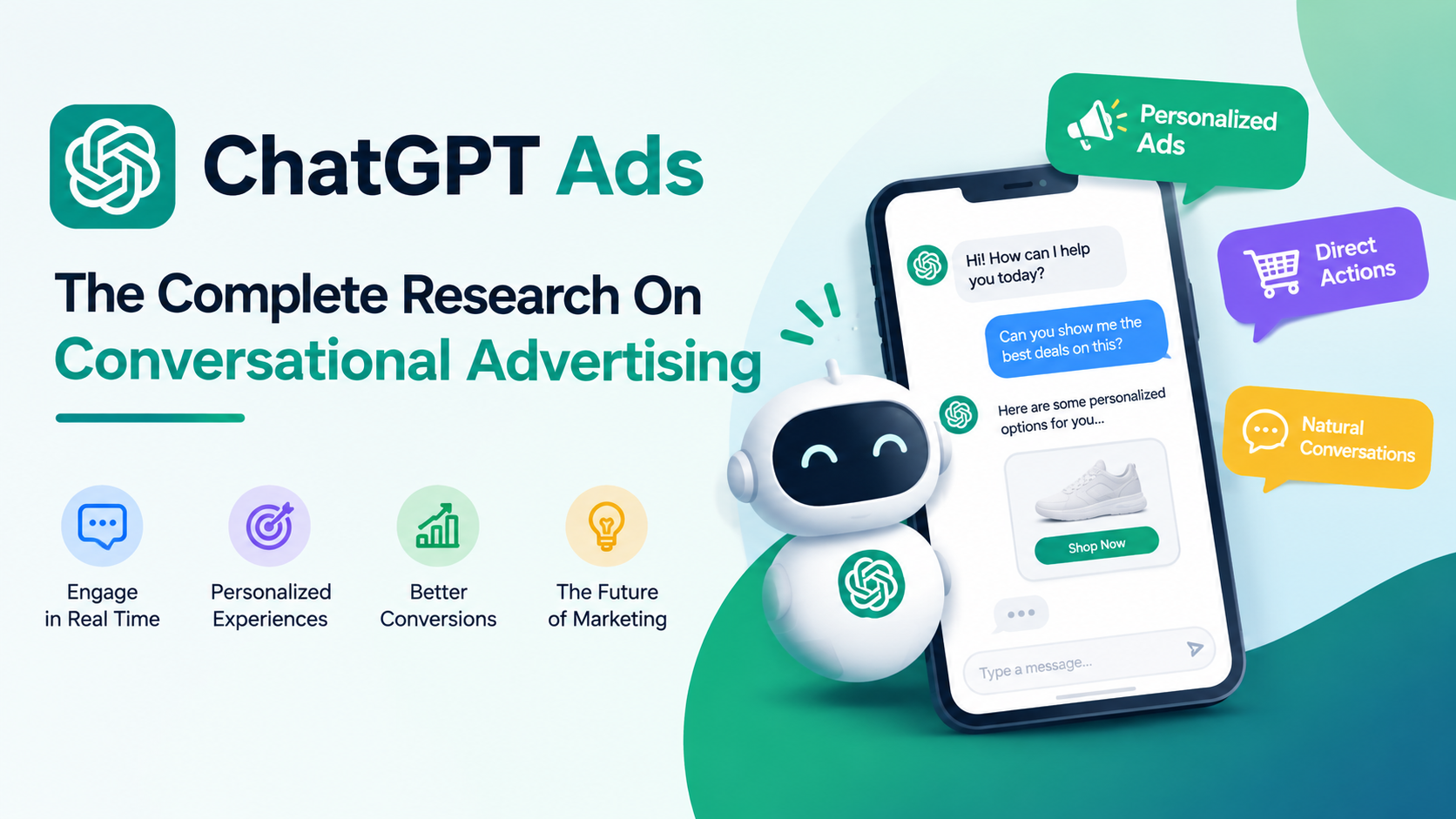
The Complete Research On Conversational Advertising
ChatGPT Ads: The Complete Research On Conversational Advertising
The way people discover products and services is changing.
Instead of typing a short keyword into a search engine, users increasingly explain what they need through detailed conversations with AI. They may describe their business, budget, location, requirements, problems, preferences and purchase considerations in a single conversation.
This creates a new advertising environment: ChatGPT Ads.
For businesses and marketers, ChatGPT Ads introduce an opportunity to reach potential customers while they are exploring options, comparing solutions and making decisions inside a conversational experience.
What Exactly Are ChatGPT Ads?
Think about the difference between traditional search advertising and conversational advertising.
Google Ads
A user searches:
"Industrial RO plant manufacturer in India"
Google can show sponsored results based on signals such as the search query, relevance, bidding, location and other campaign settings.
ChatGPT Ads
A user may instead ask:
I'm setting up a textile manufacturing unit in Coimbatore. We need an industrial RO system for around 50,000 litres per day. What should I consider?
The conversation itself provides much richer information about the user's situation and requirement.
ChatGPT Ads are designed to help advertisers reach people as they explore options, compare alternatives and make decisions. OpenAI states that ad delivery can consider signals including the current conversation's context and intent, the ad's landing page, title and copy, advertiser-provided context hints and, when ad personalization is enabled, selected signals from the user's broader ChatGPT experience.
This creates a different advertising model:
- Google Ads: Search query and intent
- Meta Ads: Audience, profile and interest signals
- ChatGPT Ads: Conversation, context, intent and relevance
The important distinction is that ChatGPT Ads are not simply another keyword advertising platform.
Where Do ChatGPT Ads Appear?
ChatGPT Ads can appear below a ChatGPT response and are clearly identified as sponsored content. The advertisement is visually separated from the answer generated by ChatGPT.
For example, a user could ask:
"What are some good laptops for video editing under ?1 lakh?"
ChatGPT provides its response.
An eligible advertiser could potentially appear below the response with an ad such as:
Sponsored | ASUS
High-performance laptops for creators
Explore creator laptops designed for video editing and demanding workflows.
Importantly, OpenAI states that advertisers cannot influence, rank or alter ChatGPT's answers. Ads operate separately from the chat model.
This distinction matters for both advertisers and users. A sponsored placement is advertising inventory, not an organic recommendation from ChatGPT.
Who Can See ChatGPT Ads?
ChatGPT advertising is currently associated with the ad-supported experience.
Ads may appear for users on the Free and Go plans. They are not shown to users on Plus, Pro, Business, Enterprise or Edu plans, and ads are not shown to accounts identified as belonging to users under 18. Availability can vary as OpenAI expands its advertising program.
For advertisers, this means campaign planning should focus on the audience and markets actually available within Ads Manager rather than assuming that every ChatGPT user is part of the advertising inventory.
Planning to advertise on ChatGPT? Start with the right audience, offer and campaign structure
How Is a ChatGPT Ads Campaign Structured?
ChatGPT Ads currently follows a three-level campaign structure:
Campaign → Ad Group → Ad
1. Campaign
The campaign establishes the overall business objective and delivery settings.
Depending on the available campaign configuration, this can include:
- Campaign objective
- Budget
- Start and end dates
- Countries
- Platforms where applicable
- Conversion event for conversion campaigns
- Custom audience inclusion or exclusion where supported
2. Ad Group
An ad group should represent a specific product, service, theme or customer need.
For example, an industrial water treatment company could structure its campaign as:
Campaign: Industrial Water Treatment Leads
- Ad Group 1: Industrial RO Plants
- Ad Group 2: Commercial RO Systems
- Ad Group 3: Water Treatment Solutions for Manufacturing
- Ad Group 4: High-Capacity Water Purification
This approach creates a closer connection between the user's requirement, the advertising message and the landing page.
OpenAI recommends separating significantly different use cases when they require different messaging or landing pages.
3. Ads
Individual ads contain elements such as the advertiser identity, title, copy, image and landing page.
Multiple distinct variations can be created within an ad group so the system has different messaging angles to work with. OpenAI specifically recommends building diverse variations rather than repeating essentially the same message.
Context Hints: The Key Difference From Traditional Keywords
One of the most important concepts for marketers to understand is context hints.
Context hints help ChatGPT's advertising system understand when an ad may be relevant.
They are not exact-match keywords or conventional keyword targeting rules. They provide additional semantic information about what the business offers, who it serves and the situations in which the offering may be useful

Weak context
RO plant, water purifier, RO system

Better context
Industrial water purification solutions for factories requiring high-capacity RO systems for manufacturing processes.

More specific context
High-capacity industrial RO solutions for manufacturing facilities researching process-water purification, production water treatment and commercial-scale water requirements.
The objective is not to create a giant keyword list. The objective is to communicate meaning and relevance. This is where SEO, semantic search, entity understanding and content strategy experience can become particularly valuable.
Not Sure How to Build Context Hints for Your Business
What Are the Main ChatGPT Ads Campaign Objectives?
ChatGPT Ads currently supports three major campaign objectives.
Views
The Views objective is designed to maximize visibility and exposure.
Billing is based on CPM, or cost per 1,000 impressions.

Brand awareness

Product visibility

Market introduction

Large-scale exposure
Clicks
The Clicks objective is designed to drive traffic to a website or landing page.
Billing is based on CPC, or cost per valid click.
This can be relevant for businesses promoting:

Product pages

Service pages

E-commerce products

Lead-generation landing pages

Business enquiries
ChatGPT conversation
Sponsored advertisement
Landing page
Enquiry / Form submission
Sales follow-up
For an e-commerce business, the journey could instead end with a purchase.
The appropriate objective therefore depends on what the business actually wants the campaign to achieve
Geographic and Audience Targeting
ChatGPT Ads campaigns can include country targeting, while additional audience controls may be available depending on campaign configuration and market.
The important point is to align geography, offer, messaging and landing page instead of simply duplicating the same campaign across every market.
Compare ChatGPT ads, Google Ads, Meta Ads and discover which is best for your business
Ready to Run ChatGPT Ads for Your Business?
ChatGPT Ads represent a new direction in digital advertising where conversation becomes an important source of advertising relevance.
At 123 Total Web Solutions, we can help businesses evaluate where ChatGPT Ads fit into their existing digital marketing strategy, develop campaign structures, build context-led advertising messages and connect campaigns with conversion-focused landing pages.
Want to know whether ChatGPT Ads can work for your business
Share your business, products or services, target country and primary goal, and our team can help you identify a suitable campaign approach.
ChatGPT Ads vs Google Ads vs Meta Ads
|
|
|
|
|
|
|
|
|
|
|
|
|
|
|
|
|
|
|
|
|
|
|
|
|
|
|
|
|
|
|
|
|
|
|
|
|
|
|
|
|
|
|
|
|
|
|
|
|
|
These channels should not necessarily be viewed as replacements for one another.
A business can use Google Ads to capture explicit search demand, Meta Ads to reach defined audience segments and ChatGPT Ads to participate in relevant conversational discovery.
How Should Businesses Prepare for ChatGPT Ads?
Running the campaign is only one part of the process.
Before investing in ChatGPT Ads, businesses should prepare:
- A clearly defined target market
- Specific products or services
- Strong customer-use cases
- Relevant context hints
- Multiple ad variations
- Dedicated landing pages
- Conversion tracking
- Clear campaign objectives
- Appropriate geographic targeting
- A process for measuring leads and revenue
For example, instead of sending every user to a generic homepage, an industrial RO manufacturer could create a dedicated landing page focused on high-capacity industrial RO solutions, specifications, applications, industries served and enquiry options.
This creates continuity between the conversation, advertisement and conversion page.
This creates continuity between the conversation, advertisement and conversion page.
Is ChatGPT Ads Right for Your Business?
ChatGPT Ads may be particularly relevant for businesses where customers spend time researching, comparing or evaluating solutions before taking action.
- B2B products
- SaaS platforms
- Professional services
- Education
- E-commerce
- Manufacturing
- Technology products
- Financial products where eligible
- Travel and hospitality
- Home and business services
The real opportunity is not simply putting an advertisement in front of a ChatGPT user.
It is connecting your business to a relevant decision-making moment.
A successful campaign therefore requires more than ad copy. It requires understanding the customer problem, developing meaningful context signals, selecting the appropriate campaign structure and building a landing experience that continues the user's journey.
We Partnered With